Saturday, April 13, 2024

I SEE THE MOON, THE MOON SEES ME


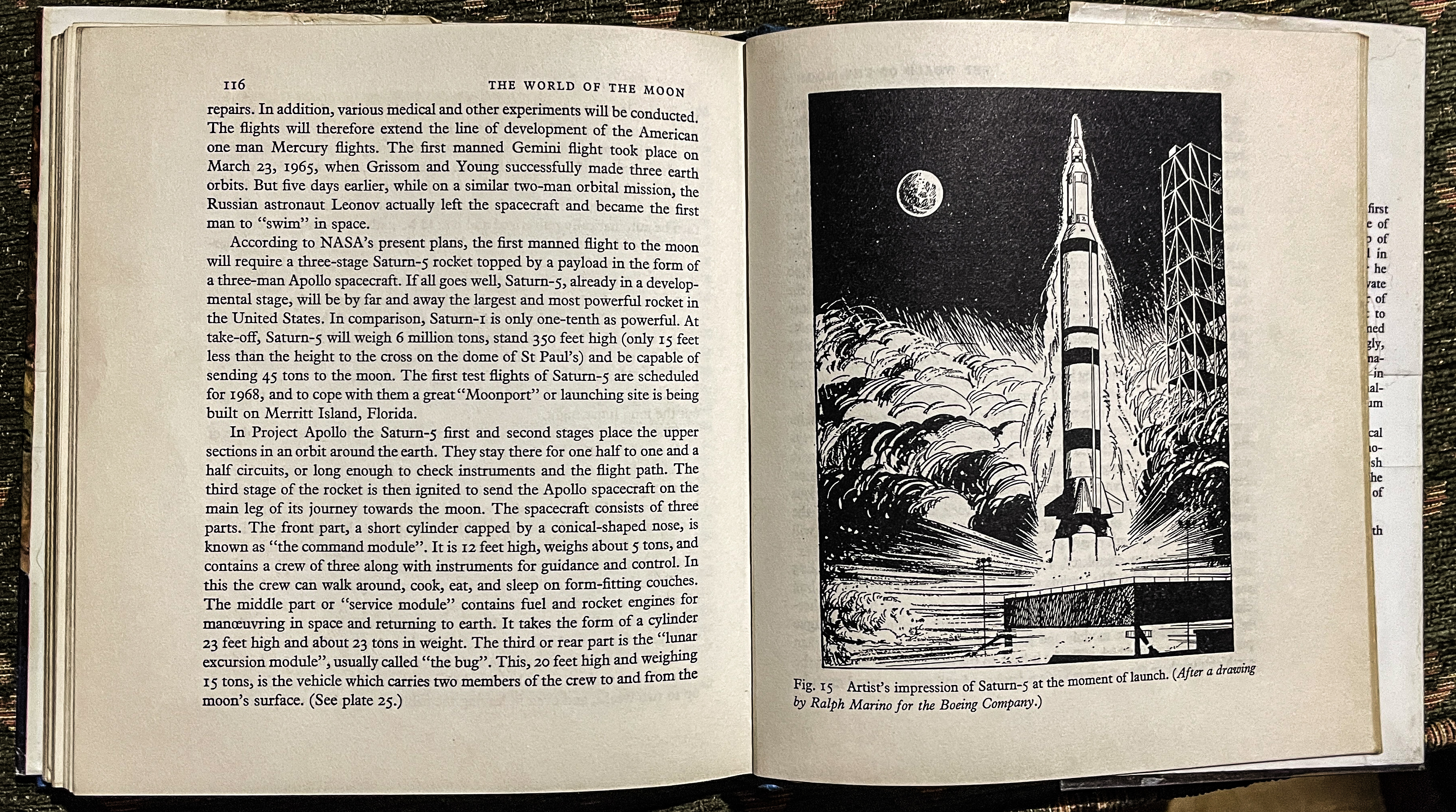
The latest in my collection of space books is a reproduction of the work of amateur astronomer Hugh Percival Wilkins, who used a 300inch telescope to sketch the lunar surface from his back garden, using the sketches to create some of the most detailed maps of the lunar surface at the time. 

His first edition was released to critical acclaim in 1946, but he continued to update and revise the map until the third edition in 1953. His map was considered the the best available for astronomers and was even bought by NASA to be used as reference for the Apollo missions and for use with the first clear photographs returned by American and Russian probes. Although his maps were criticised for being overcrowded and complex, they are amazingly accurate.

An example of two sections of the map showing the area around the crater Copernicus.


Wilkins also sketched and drew sections of landscape and individual craters by hand from his observations. The final map was a huge 100 inch diameter diagram, comprised of 25 individual sections, which when laid out covered the entire disk of the visible surface. After his death, just 9 years before the moon landing, the map was acquired by the Royal Observatory museum in Greenwich.

Lunar Atlas representation of Kepler Crater
Lunar Orbiter Photograph of Kepler

Wilkins sketch of the shadow on Kepler Crater 

Comparison of the area around Alphonsus Crater and Wilkins observational sketches of the dark area within Alphonsus, with notes regarding additional features for which he was often criticised.


Sea of Tranquility as it appears in the book
Lunar Astronautical Chart of the area around Julius Caesar crater and Sea of Tranquility

I order to check the veracity of Wilkins maps, I found the area showing part of the Sea of Tranquility, where the first moon landing took place and referenced it against the Lunar Atlas and a shot taken by the Lunar Orbiter missions.
Wilkins map inverted

Consolidated Lunar Atlas Photograph

It took a little time to identify the area in Wilkins book, but eventually I realised that the relevant map area was upside down!
Despite the orientation of the map in the book, overlaying it onto accurate astronomical charts show a remarkable level of accuracy for a hand drawn map.
Some of the features in Wilkins map do appear slightly out of position, but the map does not take into account the curvature of the lunar globe, as seen in the last photograph, so some distortion and some aberration due to the lens of the telescope must be allowed for.


Thursday, April 11, 2024

A BLAST FROM THE PAST

Growing up, I paid frequent visits to the local library, as well as a much smaller one in school and regularly combed the shelves for any interesting space books. The majority were dry, text heavy volumes, but now and again, I would come across a book which knew its intended audience and catered for it with interesting articles intended for a younger audience and a range of exciting images to catch the eye. Martin L Keen published 'Rockets, Missiles and Spacecraft' under the Odhams imprint, who were responsible for a lot of younger readers books in the sixties. 

The cover shows a painting by renowned artist Robert McCall, who was employed to visualise may NASA projects.

It fell in the period just prior to the Apollo Moon Landing era, when excitement and anticipation were high and featured some early prototype designs for the apollo program. At the time, I assumed they would be the designs of the vehicles which would land on the moon and very much like the space shuttle program some decades later, I was very disappointed with the actual craft!

The book shows a photograph of something which is clearly a model from one of the proposals submitted to NASA by the several engineering companies who applied for the contract, possibly Bell Aerospace.
Other interesting illustrations include the Dyna Soar glider, atop a modified Titan rocket launcher, with large stabilising fins and some excellent artwork relating to the Gemini programme. Besides good photo coverage, Keen also includes some illustrative work, with drawings and illustrations of various rockets and missiles. These vary in style and quality, but one in particular always made me quite curious. this was a drawing of an air to surface missile called the Army 'Rascal' and the drawing seemed to represent a childs toy aircraft, rather than a missile. the accompanying drawings are fairly accurate and recognisable, but the Rascal bears no relation to the actual missile, as seen below.


The Rascal was a large supersonic missile launched from a modified B52 Bomber. It was in use until 1958, when it was decomissioned.
At the time of publication, accurate information on the Apollo project was clearly being kept under wraps, as the Saturn launch vehicle for the mission is shown at a very early conceptual stage. It is also accompanied by the projected heavy lift vehicle Nova, which was intended to be many time larger and be used to transport cargo to the moon.
My favourite sections of all space books is always the future developments, or 'beyond the moon' chapters, which look ahead to possible interplanetary missions, or exotic fuel craft. This book is no exception and has designs for ion powered, nuclear fuelled craft. 

One thing which always intrigued me about this particular section was the inclusion of a series of probes designed to explore Mars, with a view to discovering life. A trio of similar designs are shown, each shaped like a rocket nose cone. The first one is Project Gulliver - named after Jonathan Swifts famous explorer, who in the book 'Gullivers Travels' famously predicted the presence of two moons orbiting Mars and came surprisingly close to guessing their orbital trajectory. The Gulliver probe was intended to land on the planets surface and shoot out tethered projectiles on to the surface, with cables coated in a sticky film. these would then be retracted, drawing in soil and dust samples for analysis.


Two similar probes, he Multivator and Wolf Trap, used similar devices to test for the presence of life. Unfortunately, none of the designs were ever approved and the Viking probes were eventually dispatched to Mars, but failed to identify any organic compounds.

All in all a great book and one of the rare occasions when i have bought two copies, as the first one I had was a little shelf worn, but the quality justified finding a second good copy for the shelf. having the older copy enabled me to scan the pages, too - rather than relying on photographing  a spread.


Monday, March 25, 2024

HEAVENS ABOVE


A recent eBay search for something different brought this latest book to my attention, chiefly because of the early style of the illustration on the cover. Once more it was a ‘blind buy’, as although other vendors had copies for sale, none of them had previews of the interior. I put it into my Watched items section and moved on. As often happens with eBay lately, after a few hours, the seller sent me an offer price, reducing the cost by a few pounds and making a possible purchase into a concrete one. With free postage too, as it was from one of the many discount book resellers, it was a simple choice. Not two days later, the book arrived and initially, I was quite surprised how small it was - about 6” on a side and a page count of 127. My only reservation was that it was an ex-library book (which was indicated in the listing) and so it had a thick polythene cover over the dust jacket. This had yellowed with age and ripped the fragile dust jacket a little as it was removed. However, some archival book tape made good the damage.

The author was listed as one Dr Henry C King of the London Planetarium, so it was always going to be a book with a more astronomical bent than I would have preferred, but even so the information inside was of a very high quality.
Large full page spreads were devoted to clear and detailed images of the moons phases, with excellent resolution on the near side, showing the rilles and craters. The acknowledgements in the foreword indicate that these were taken with the American Lick and Mount Palomar telescope observatories and are of stunning quality.                                                                                                                                                                                  
As the volume is dated 1966, it sits at the crucial period of lunar exploration, when both the US and Russia were still gripped in the race for the moon and we’re desperate to map the surface in advance of a landing. 
The only photograph of the far side is provided by the Soviet Lunik III probe which flew past the moon in 1959, showing the hidden far side for the first time. the book also includes shots from the American Ranger series probes - 7 and 8 and a large photograph of the first Surveyor soft landing probe, which was due to launch the year the book was published and a model of the projected Lunar Orbiter satellite, which would be instrumental in the selection of the future landing site of the Apollo mission, just four years later.
It rounds out the chapter with an early painting of the projected Apollo Command Module and LEM showing a long legged version of the landing craft, which was under development at the time. All in all it is a nice little book, with some excellent information and one or two simple line drawings. The smaller ‘pocket size’ of the book makes it quite attractive too.

Some time earlier, I had picked up a souvenir booklet from the London Planetarium - its undated but seems to be from shortly after the building was opened, in 1958. It’s a slim volume, with lots of information about the Zeiss projector installed in the new building, which was at the time cutting edge and only one of five to leave the German factories, for export. 

The director of the Planetarium was our friend Dr King, who was writer of the previous book and the souvenir has a brief biography of him.


Once more the booklet is full of beautiful black and white photographs of astronomical phenomena, such as star and galaxies - which are again credited to the Lick and Palomar Observatories.
The images of the gas giants and inner planets, however are still quite indistinct and a long way from the material which would be provided by modern probes, some forty years later.

The spread on the moon is very reminiscent of Dr Kings book, showing a large photograph of the lunar disk. It’s apparent that this spread has a distinct yellow discolouration on the pages, as when it arrived, I found it held a newspaper clipping for the Daily Telegraph, from 1958 with a lunar globe on it, still pressed between the pages.
The illustration has all the major surface features listed and the brief text accompanying the illustration indicates the first probe to be sent to the Moon was on the launch pad, atop a Thor Able rocket.

This would appear to refer to ‘Pioneer 0’ or Able 1 as it was officially designated and was the US Air Force's first attempt to launch a probe to the Moon. The launch failed, as the rocket exploded 9 miles into its journey. It marked the beginning of the series of deep space probe launches and predated the formation of NASA and was humanity’s first attempt at sending a spacecraft beyond the orbit of Earth.


Friday, February 16, 2024

RED MOON IN ORBIT

Looking at vintage information regarding the space race is always a fascinating exercise, as besides the wonderful diagrams and illustrations it can turn up, there is a wealth of information waiting to be uncovered. The power granted by the internet means that access to materials which at the time would be impossible to find, let alone view, is now comparatively easy. The Freedom of Information Act, meant that previously top secret documentation can now be viewed without restriction, as the period covered by the classified status has long since expired. 

Such an example appeared recently, whilst I was looking for some image for another post and I found a US Air Force site, showing declassified historical documents. 

One particular post stood out, as it dealt with a 'Sputnik-46' satellite launch. As far as I was aware, there had only been three Sputnik satellite launches, so I was quite intrigued and read  the document. It turned out that it was a report from an Air Force monitoring station, which during the Cold War years, kept a watch on Soviet launches. 'Sputnik-46' was a code name for an object which had been launched from the Tyuratam Base (now Baikonour Cosmodrome) in November 1963. The Soviets had already stolen a march on the West with the orbit of Yuri Gararin in Vostok 1 and the launch of the first artificial satellite Sputnik 1 and would shortly find success with the three man craft Voskhod 1 in 1964. Mindful that the race was on to visit the Moon, either with a manned mission or remote probes, the Soviet Union were desperately trying to send a satellite to either Venus or Mars, to achieve yet another soviet first.

The document in question details the launch and apparent failure of  'Sputnik-46' and gives details of the radar observations of the object. Its interesting to read the message, as it shows the extreme accuracy by which the object could be tracked, with dimensions and descriptions of the orbiting parts, including a tiny plate around a foot long.


 Here is an edited transcript of the main message:

AF IN: 20080 (12 Nov 63)
ON 11 NOVEMBER AT APPROXIMATELY 0625Z THE SOVIET UNION LAUNCHED AN EARTH SATELLITE VEHICLE FROM THE TYURATAM MISSILE TEST RANGE. 
THIS LAUNCH WAS DETECTED BY THE SHEMYA RADAR FACILITY AND LATER RADAR DATA HAS BEEN OBTAINED FROM OTHER SPADATS FACILITIES. 
THIS LAUNCH HAS BEEN DESIGNATED SPUTNIK 46, THREE OBJECTS HAVE BEEN DETECTED IN THIS ORBIT, AND ORBITAL PARAMETERS HAVE BEEN OBTAINED ON TWO OF THESE. 


THE SPUTNIK 46 ORBIT IS A NOMINAL 65 DEGREE INCLINATION ORBIT, AS WE HAVE SEEN ON ALL PREVIOUS LAUNCHES FROM THE TYURATAM MISSILE TEST RANGE EXCEPT FOR SPUTNIK 45. OF THE THREE OBJECTS IN THE SPUTNIK 46 ORBIT, THE TRAILING PIECE HAS BEEN TENTATIVELY IDENTIFIED AS THE PAYLOAD, AND HAS BEEN DESIGNATED SPADATS OBJECT NUMBER 687.

INITAL RADAR SIGNATURE ANALYSIS INDICATES THAT THE ROUGH SHAPE OF OBJECT 687 APPEARS TO BE A CONE-CYLINDER, LENGTH APPROXIMATELY 5 FEET AND DIAMETER APPROXIMATELY 3 FEET. IT APPEARS TO BE TUMBLING WITH A PERIOD OF APPROXIMATELY 5 SECONDS (12RPM). 

THE LEADING OBJECT IN THIS ORBIT HAS BEEN TENTATIVELY IDENTIFIED AS THE INJECTION STAGE ROCKET BODY, AND HAS BEEB DESIGNATED SPADATS OBJECT NUMBER 688.OBJECT 688 IS LEADING OBJECT 687 BY 6.5 MINUTES AS OF REVOLUTION 27. RADAR SIGNATURE ANALYSIS INDICATES THAT OBJECT 688 APPEARS TO BE BASICALLY CYLINDRICAL, PERHAPS WITH A SLIGHT TAPER. LENGTH APPEARS TO BE 10-16 FEET, WITH DIAMETER 4.5-6.5 FEET. 
 
THE REMAINING OBJECT IN THE SPUTNIK 45 ORBIT IS LEADING OBJECT 687 AND LAGGING OBJECT 688. AS OF REVOLUTION 6 IT WAS LEADING OBJECT 687 BY APPROXIMATELY ONE MINUTE. DUE TO THE SMALL SIZE OF THIS OBJECT, THERE HAS NOT BEEN SUFFICIENT RADAR DATA OBTAINED AS YET FOR THE CALCULATION OF ORBITAL PARAMETERS. THEREFORE THIS PIECE HAS NOT RECEIVED A SPADATS OBJECT NUMBER AS YET. RADAR SIGNATURE ANALYSIS INDICATES THAT THIS PIECE APPEARS TO BE A SMALL FRAGMENT, WITH A DIAMETER OF ROUGHLY SIX TO TWELVE INCHES. THERE ARE VERY TENTATIVE INDICATIONS THAT IS SOME SORT OF PLATE. IT IS TUMBLING RAPIDLY WITH A PERIOD OF ROUGHLY 0.7 SECONDS C86 RPM).

NO CONFIRMED TELEMETRY HAS BEEN INTERCEPTED FROM SPUTNIK 46 SINCE INITIAL REVOLUTION. TASS HAS MADE NO ANNOUNCEMENT CONCERNING THIS LAUNCH. THE SOVIETS NORMALLY ANNOUNCE A SUCCESSFUL OPERATION. DUE TO LACK OF TELEMETRY SINCE ZERO REVOLUTION, HIGH TUMBLE RATE OF PAYLOAD, AND ABSENCE OF SOVIET ANNOUNCEMENTS, IT IS TENTATIVELY SUGGESTED THAT THE PAYLOAD HAS FAILED TO PERFORM SUCCESSFULLY. 

FURTHER INFORMATION WILL BE FURNISHED AS AVAILABLE IN VIEW OF THE LACK OF PUBLIC ANNOUNCEMENTS OF THIS LAUNCH, IT IS ANTICIPATED THAT SPADATS BULLETINS ON THIS LAUNCH WILL CONTINUE TO BE ISSUED AT SECRET LEVEL.

I was curious to know what this object may have been, as I was unaware of any probes launched around this time, so turned to the internet for answers. Research indicated that the object had been given the classification of  'Kosmos 21' - Kosmos being a label given to record failed launches or missions, which were not formally disclosed, as the Kremlin was not keen to publicise its failures, as the U.S did. Once more, with the iron curtain having been partly removed over the last few decades, information was more readily available.


The Kosmos 21 mission was to have been a test for a new planetary probe, which would ultimately produce the Venera series of vehicles and was based on the 3MV-1A base model. This included a sealed instrument component and a landing vehicle, attached to a motor unit. Kosmos 21 would have received the official designated of 'Zond 1' and was intended to be launched into high orbit, operate some remote manoeuvres and return to Earth. Unfortunately, due to the haste with which the probe was developed and problems with the Molniya launch vehicle, the final stage of the rocket had misfired and placed Kosmos 21 in an unstable orbit. Further problems had probably resulted in an onboard explosion, disabling the probe and resulting in the debris tail. The probe eventually re-entered the atmosphere and was destroyed. 

Further problems with the 3MV-1A series continued, with a second launch in March the following year, which  left the probe in high orbit. This was designated Kosmos 27. 

Zond 1 made a successful launch as was officially recognised by the Soviet Union, but en route to Venus, problems with the casing led to depressurisation and a failure of the radio transmitter. The probe continued on its journey and silently passed Venus within 100,000 miles.

ABDUCTING ALIENS

I have just finished watching Steven Spielbergs latest film 'Disclosure Day', which revolves around a government cover-up of alien c...