Showing posts with label PROJECT SWORD. Show all posts

Friday, June 24, 2022

RENDEZVOUS IN ORBIT


 One of the most exciting things I noticed as a boy, growing up in the space race, was the close connection between toys and the space books, that I loved. Obviously there were the marketing tie ins with TV series and toys and annuals, but every now and again, I would find a toy that was 'unofficially' based on a NASA design or illustration from the pages of one of my favourite books.
The two main culprits for this were Project SWORD toys and Triang Spacex, but other companies such as sweet and cereal producers took advantage of the wealth of space imagery in the news at the time.

This was great news for me, as I could easily obtain actual models and toys based on the fabulous machines I was seeing in the books. It would be many years later, after the advent of the internet and the publication of Moonbase Central blog, that I would finally be able to identify the connections between the toys and their respective origins, but at the time, it was an intriguing mystery for me to pursue.
Kelloggs Space Age Miniatures and Triang Spacex Molabs


Even today, part of the drive to find early space books is the hope that in their pages, I will discover more illustrations which relate to my favourite toy lines. Most of the origins have now been established, after several years of dilligent research by the Moonbase Central team, and they are available on the blog, but there are still plenty of connections to be made.


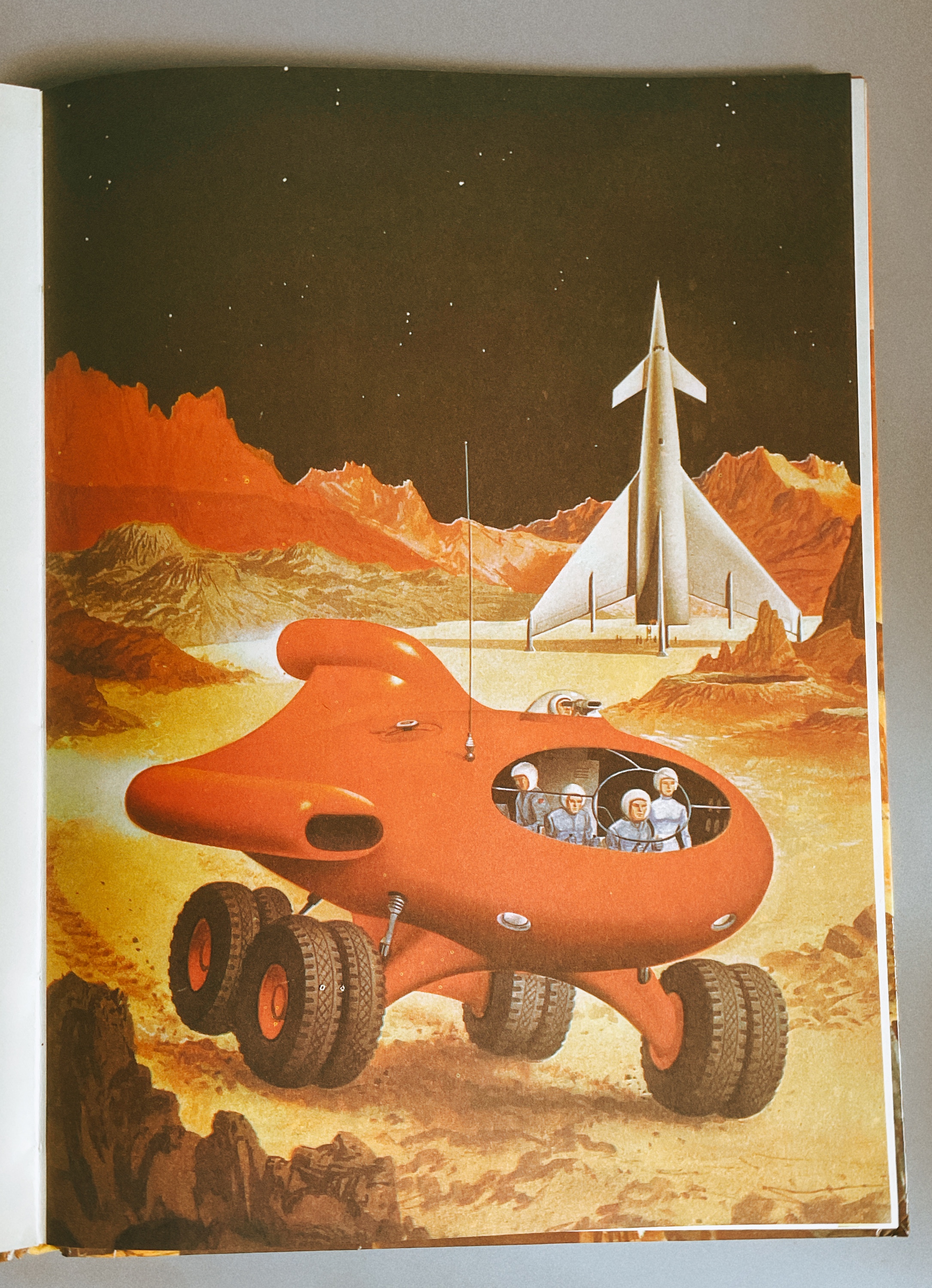
Easily one of the best examples of referencing material is the excellent 1964  Time Life book 'Man and Space', with text by Arthur C. Clarke and illustrations by Ed Valigursky. Aside from being a wonderful primer for the space programme, it contains some absolutely lavish full colour paintings, which clearly influenced the design of the Project SWORD and SPACEX toy ranges.

The book has several large painted illustrations by Valigursky, which were the direct inspiration for space toys in the sixties, made by both Triang and Century 21, who both had connections with the Gerry Anderson franchises.
Unproduced Sword Moonbase Playset


Valigursky's Moon Base
I first came across the book in the local library and marvelled at the gorgeous painted interpretations of the Explorer MEV 2 and Booster Rocket. Shortly after I became a contributor to the Moonbase Central blog, I became aware of several books which had a strong connection to the toy world and Man and Space was one of the main referents. It then became a mission to try and find these books for sale, so I searched ebay and other second hand book sites to find them. Luckily, the Time Life series had a wide publication, so it was fairly simple to find a good copy.
Valigursky's Moon Vehicle and Spacex MEV2 toys


I had owned a copy of the Project SWORD annual since its release in 1968 and was very familiar with the amazing artwork and actually owned some of the toys. The advent of ebay and internet research made it practical to obtain more of the toys and a second copy of the annual, as my own had suffered over the years.
Once more Valigurskys paintings had been used as the basis for toy designs, as the Sword and Spacex Booster Rocket toys clearly show.
Valigurskys Booster Rocket 


One of the most enigmatic toys from the Project Sword range was the Nuclear Ferry. This was shown in the product catalogue which came with each toy and was widely advertised in comics, but was never available in the stores.


Once more, it appeared in print, initially I discovered it in an edition of Look and Learn magazine, but I discovered much later that it had already appeared in Life magazine around 1966 and the illustration was by Robert McCall. Again, many years later a toy appeared on Yahoo auctions Japan, the only instance of the toy ever seen. Since that date in the mid 2000's, only four models have been found, one of which I am very lucky to own.

The Triang Spacex series also included a small plastic version of the craft too, which also surfaced for the first time around 2004. It would be around this time that I contacted David Portree who ran the 'Beyond Apollo' space blog and he identified the design as being a proposal by Ling Temco Vought for a nuclear shuttle, which McCalls original painting in Life magazine illustrated and which became the inspiration for both toys.


There are many other instances of toys and models copying or referencing book illustrations, both intentionally and without acknowledgement. Hong Kong toy companies were notorious for blatantly lifting pictures and applying them to toy packaging. Even other book publishers re-used existing illustrations, or slavishly copied them for their own use. See this full page illustration for an extreme environment space suit, originally shown in 'Man and Space' but copied for the 'Daily Mirror Book of Space'.


Friday, June 10, 2022

RETRO ROCKETS

Before I go further into my examination of the collection of books and resources that I have collected over the years, its important to note a starting point, before the journey gets underway.

Around 1969, as I watched the moon landing live on our black and white TV, I had begun to collect space books as a matter of course. My family would be primarily responsible for the early ones, but I eagerly pointed out choice volumes that I liked the look of, usually for christmas or birthday gifts. 

The following year, with the moon landing out of the way, the Moon Rock went on worldwide tour and came to our local museum in Liverpool. My sisters, probably more curious than I at the time, took me into town and we queued up for about an hour to get into the museum and a brief look at what I saw at the time, as a piece of coal under a double glass dome. I was seriously underwhelmed, but went along with the hype and excitement of the occasion, gathering up all the free handouts of photocopied material and accepting a black and white photograph of the coal in the grip of its silver stand, as a souvenir.
When we got home, my elder sisters in fine home schooling tradition suggested I get a scrapbook and put the handouts and other bits in for 'safe keeping'. I wasn't much concerned with the reams of text material, which didn't have any interesting illustrations at all, just some drawings of 'tektites'. Needless to say, I got out the glue and plastic scissors and slapped everything into a cheap scrapbook, that was provided for me from the corner shop. Over the next few weeks, the Radio Times and any other newspaper I could find, were summarily chopped up and slapped into the book.

Visiting my grans house, we found other old newspapers from previous years and I cut out a couple of articles on early Mariner missions to Mars. A TV Times Xmas Special had a nice silver and red Apollo capsule being drawn by reindeer, so that was hacked out and put in, along with a nice moon map.

If it was moon or space related, it went in the scrapbook. Unfortunately, left to my own devices, I was a bit heavy handed with the glue and quite careless with the scissors, so the end result was a bit of a dogs breakfast.
Along with space articles, I found a lovely photo spread of a model of what I took to be a 'space city' which turned out years later to be a map of the pavilion for Expo 70. At the time, I wasn't concerned about what an 'expo' was, but it looked spacey, so it deserved a place.

My dad knew a good book when he saw one and ensured his three children were surrounded with sound educational materials. As a result, the girls and myself all had a series of Ladybird books. I was delighted when the nature dominated series expanded to include science and two gorgeously illustrated space volumes.
At some point I would probably have marched these with me to primary school, so it was essential to put my name in them. This dates them very accurately, as 'Exploring Space' marks the transition from the address where I was born, to the house we moved to when I was 8. 


'How It Works: The Rocket' received the updated address in flowery purple cursive. 

Possibly two of the very first space books are these tiny board backed Orbit Books. Part One and Two included minimal text and a full page painted illustration and introduced me to the delights of the X-15 Rocket Plane and the huge Nova Rocket.

Some time after, as shown by the presence of Skylab, albeit as the projected shape, rather than the abortive reality, the 'Inside Information' series of books by Eagle comic artist Lesley Ashwell Wood, released a fine volume of Space Travel. With this series, I was always excited to go to the last pages to see the 'What of the Future?' section, which with Space Travel was a rather disappointing swing wing shuttle. 

However, besides all the text and non-fiction books depicting real world space race events and actual vehicles, one particular book stands out clearly. The influence of the 1968 Project SWORD annual cannot be understated. With its accompanying toy line and fabulous spaceship designs, it set the benchmark for all spaceship designs to come and disillusioned me with the meagre efforts of NASA.
The world of Project SWORD and the fantastic series of toys and the related SPACEX series are well documented on the companion blog to this one, Moonbase Central. In its 15 year history, myself and blog owner Paul Woods have discussed the origin of Sword and collected the toy line which obsessed us both as kids. For more information, see the link at bottom of the page.


HOT CHOCOLATE

    A while ago, I was very pleased to receive this wonderful large format album of what looked like space stickers, from my good friend and...